

In today’s digital landscape, where millions of people search for products, services, and answers on Google every single second, visibility is no longer an optional luxury—it is the variable that determines a business’s survival and growth.
If you have ever wondered what SEO is and what it actually does in a real-world business context—beyond abstract, technical definitions—the simple answer is this: SEO is the engine that turns your potential customers’ searches into recurring, sustainable revenue for your business.
Throughout this in-depth guide, we will break down everything from operational fundamentals to advanced organic positioning strategies, while evaluating their return on investment, how they differ from paid advertising, and the impact they have on brand authority.
What is SEO? Technical and conceptual definition
The acronym SEO stands for the English term “Search Engine Optimization.“
In technical terms, SEO is a collection of disciplines, methodologies, code optimizations, content creation, and authority-building actions designed to improve a website’s position on search engine results pages (SERPs) organically—that is, without paying directly for each click received.
In strategic and business terms, SEO is the digital architecture that enables your company to be present at the exact moment a user expresses a commercial need or a relevant query on search engines like Google, Bing, or DuckDuckGo.
[User Search] ➔ [Algorithm evaluates relevance and authority] ➔ [Ranked SEO results] ➔ [Qualified traffic] ➔ [Conversion / Sale]How does a search engine work?
To understand SEO, it is vital to grasp the three-step process carried out by Google’s crawlers or bots (such as Googlebot):
- Crawling: Bots traverse the web, following links to discover new or updated pages.
- Indexing: The crawled pages are analyzed, processed, and stored in a massive index (Google’s global database).
- Ranking: When a user performs a search, the algorithm consults the index and orders the results based on more than 200 factors related to relevance, usability, and authority.
What is the purpose of SEO for a business? Its direct commercial impact
Many executives make the mistake of classifying SEO as a simple marketing expense for “attracting visits.” In reality, however, strategic web positioning functions as a digital asset that gains value over time.
1. Attracting traffic with high purchase intent
Unlike interruption-based advertising (such as television commercials or social media banner ads), SEO addresses existing demand. When someone searches on Google for “advertising agency for businesses” or “electronic invoicing software,” that person has already identified a problem and is actively seeking a solution. SEO places you directly in front of that qualified buyer.
2. Sustained reduction in Customer Acquisition Cost (CAC)
Although paid digital advertising (Google Ads or Meta Ads) is effective for generating immediate results, the moment you stop your advertising budget, traffic drops to zero. SEO requires an initial investment of time and resources, but it produces a steady flow of traffic in the long term, with no marginal cost per click.
3. Building brand authority and trust (E-E-A-T)
Google prioritizes content that demonstrates Experience, Expertise, Authoritativeness, and Trustworthiness (E-E-A-T). Achieving top organic search rankings sends an implicit signal to the consumer: Google trusts this company as the most relevant answer within the sector.
4. Full-funnel coverage (Funnel Marketing)
SEO is not just for direct sales. It allows you to support the user throughout every stage of their decision-making process:
- TOFU (Top of Funnel): Addressing general questions (e.g., “How can a business automate its sales?“).
- MOFU (Middle of Funnel): Offer comparisons and research (e.g., best CRM tools for SMEs).
- BOFU (Bottom of Funnel): Capturing the transaction (signing up for an online CRM service).
The three fundamental pillars of SEO
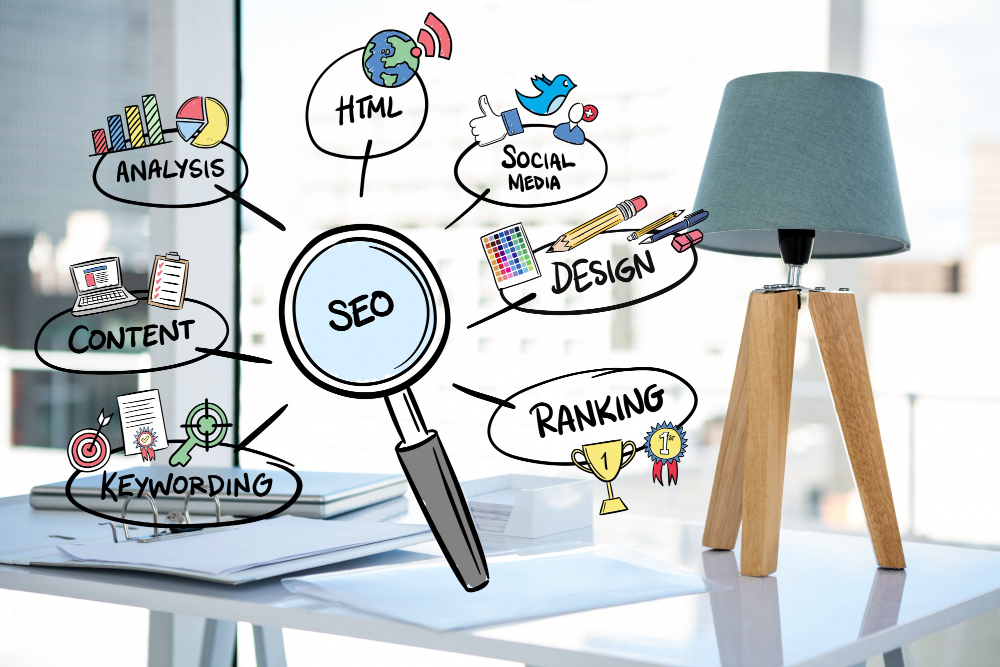
A solid positioning is not achieved by isolating factors. It requires a holistic strategy based on three interconnected pillars:
                  +-----------------------------------+
                  |             TOTAL SEO             |
                  +-----------------------------------+
                                    |
        +---------------------------+---------------------------+
        |                           |                           |
+---------------+           +---------------+           +---------------+
|  Technical SEO|           |  SEO On-Page  |           |  SEO Off-Page |
+---------------+           +---------------+           +---------------+
| Speed         |           | Keywords      |           | Backlinks     |
| Indexability  |           | Content       |           | Authority     |
| Architecture  |           | UX / Search   |           | Mentions      |
| Architecture  |           | Intent        |           | Relations     |
+---------------+           +---------------+           +---------------+
1. Technical SEO
It is the foundation upon which the entire site is built. It ensures that search engines can crawl, interpret, and index the page without any impediments.
- Loading speed (Core Web Vitals): Metrics for performance, interactivity, and visual stability.
- Web architecture: Logical URL structure and clear categorization of information.
- Mobile adaptability (Mobile-First Indexing): Seamless optimization for smartphones.
- Security (HTTPS): Data encryption certificates, essential for user and search engine trust.
- Sitemaps and Robots.txt: Guideline files to direct the crawling process of search engine bots.
2. On-Page SEO
Covers all optimizations applied directly within the website’s content and interface.
- Search Intent: Understanding exactly what a user expects to find when searching for a specific term (whether it be information, a transaction, navigation, or a comparison).
- Keyword Optimization: The intelligent use of primary and secondary keywords, as well as semantic terms, within headings (H1, H2, H3), body text, and meta tags.
- User Experience (UX) and Copywriting: Persuasive, clear writing, structured with lists, tables, and visual elements to maintain user attention.
- Internal Linking (Interlinking): Strategically connecting pages within the same domain to distribute authority and help users navigate the site.
3. Off-Page SEO (Off-site SEO)
It encompasses actions carried out outside the website to demonstrate to Google that your platform is influential and respected within its industry.
- Link Building: Acquiring mentions and backlinks from high-authority websites that are relevant to the topic.
- Brand Signals and Digital PR: Presence in media outlets, opinion pieces, and organic mentions without a link.
- Local Presence: Optimized profiles on map platforms and local business directories.
SEO vs. SEM: How do they differ, and which one does your business need?
There is a common confusion between SEO (Search Engine Optimization) and SEM (Search Engine Marketing—typically focused on paid advertising in search engines). Both models aim for visibility in search engines, but they operate based on radically different logics.
| Feature | SEO (Organic Search Positioning) | SEM / Google Ads (Paid Advertise) |
| Cost Per Click (CPC) | $0 (You do not pay for the visits received). | You pay for each user who clicks on the ad. |
| Time for results | Medium to long term (3 to 9 months). | Immediate (As soon as the campaign is approved). |
| Sustainability | Enduring. Traffic is sustained if the content retains value. | Ephemeral. When the budget is paused, visibility disappears. |
| Click-Through Rate (CTR) | Greater user trust (typically accounts for over 60% of clicks). | Lower overall CTR due to the “Ad” label. |
| Message control | Google decides which snippet to display based on relevance. | Total control over texts, extensions, and landing pages. |
The ideal hybrid strategy
It is not a matter of choosing one option to the exclusion of the other. High-growth companies use SEM to capture immediate transactional demand and validate keywords, while simultaneously developing an SEO strategy to dominate the organic market and stabilize advertising costs over time.
Types of SEO based on your business goals
Depending on your organization’s business model, the positioning strategy will take different forms:
Local SEO (Google Maps and Geolocated Searches)
Crucial for businesses with a physical location or those providing services within specific geographic areas (restaurants, clinics, local agencies, law firms).
- In-depth optimization of the Google Business Profile listing.
- Inclusion of consistent NAP (Name, Address, Phone number) data across the web and directories.
- Management of reviews and ratings from local customers.
SEO for E-commerce (Online Stores)
Focused on extensive catalogs with high transactional competition.
- Optimized category and subcategory architecture.
- Creation of original product descriptions, avoiding duplicate content.
- Implementation of structured data to display prices, stock status, and star ratings in the SERP.
B2B and Lead Generation SEO
Geared toward complex sales, long decision-making cycles, or corporate services.
- Creation of in-depth content, e-books, success stories, and white papers.
- Positioning for long-tail keywords aligned with the specific intent of decision-makers.
Common SEO mistakes that hinder business growth
Even companies with a marketing budget make strategic errors that neutralize their positioning efforts:
- Creating content designed for the company rather than the user: Writing insular, corporate-focused posts instead of addressing the actual questions that potential customers are searching for on Google.
- Ignoring page load speed and the mobile experience: Having a website that is aesthetically pleasing but extremely slow on smartphones destroys your search rankings.
- Keyword cannibalization: Having multiple pages on the same site competing for the same keyword, which confuses Google’s algorithm.
- Purchasing links from low-quality “link farms”: Resorting to prohibited tactics (Black Hat SEO) that lead to algorithmic or manual penalties from Google.
- Failing to measure results using business metrics: Gauging success solely by “total visits” without analyzing lead conversions, phone calls, or actual sales generated through organic channels.
Success stories and applied best practices
Hypothetical Case Study: Transformation of a B2B SME
A software company for logistics management relied 100% on cold calling and Meta ads, with a high CAC.
When implementing an SEO strategy focused on:
- Address operational questions specific to the sector (e.g., “How to optimize delivery routes for an in-house fleet”).
- Optimize website speed, reducing load time from 4.2 seconds to 1.1 seconds.
- Redesign service pages to align with transactional intent.
Results after 8 months:
- 310% increase in qualified organic traffic.
- 45% reduction in overall Customer Acquisition Cost.
- Daily acquisition of product demos without relying exclusively on daily ad spend.
Frequently Asked Questions about SEO (FAQs)
How long does it take for SEO to yield results?
Initial changes in indexing and improvements in rankings are typically observed between 3 and 6 months. However, substantial, sustained traffic and a solid return on investment generally materialize after 6 to 12 months of continuous work.
Can I do SEO myself, or do I need an agency?
You can learn the fundamentals and implement basic on-page optimizations. However, a competitive strategy in sectors with medium or high levels of competition requires specialized knowledge in technical development, data analysis, persuasive copywriting, and authority building (link building).
Why doesn’t my website appear on Google?
The most common causes are: the site is too new and has not yet been indexed, the website blocks crawlers via the robots.txt file, there are no backlinks pointing to the site, or the page has been hit by an algorithmic penalty.
Is SEO a one-time task or is it ongoing?
It is an ongoing process. Google’s algorithms are constantly updated, competitors create new content daily, and user search intent evolves. Maintaining top rankings requires constant upkeep, updates, and technical monitoring.
What are keywords?
These are the exact terms or phrases that users type into the Google search box. Identifying keywords with search volume and commercial intent is the cornerstone upon which any SEO content strategy is built.
How important is artificial intelligence in today’s SEO?
AI enables faster processing of search data, optimized competitive analysis, and accelerated drafting. However, Google penalizes automated content that lacks added value; human oversight, strategic judgment, personal experience, and real-world data are essential for achieving search rankings.
Can the number one spot on Google be guaranteed through SEO?
No ethical agency or specialist can categorically guarantee the absolute top position for ultra-competitive keywords, as the algorithm is proprietary to Google and varies based on location and user behavior. What can be guaranteed is the application of proven methodologies to maximize the chances of dominating the first page.
What tools are used to measure SEO?
Essential tools include free, official platforms such as Google Search Console and Google Analytics, alongside professional competitive analysis software like Ahrefs, SEMrush, or Screaming Frog.
Conclusion
SEO is not merely a technical trick to deceive search engines, nor is it a fleeting marketing tactic. It is the methodical construction of your company’s digital presence, ensuring that your value proposition is prominently visible to users who are already searching for what you offer.
Investing in organic positioning means building an asset of your own—one that shields your business from the volatility of advertising costs, strengthens your brand credibility, and generates a continuous stream of long-term business opportunities.
Ready to dominate the top positions on Google?
If you want to transform your website into a machine that consistently generates qualified leads—using SEO strategies tailored to your industry—at CREATIVOENLINEA, we design and implement digital architectures focused on delivering real business results.
Solicita una Auditoría SEO para tu empresa con el equipo de CREATIVOENLINEA
External references
To reinforce the trust signals (EEAT) of the article, it is suggested to link to the following high-authority official resources within the technical body of the guide:
- Official Google quality guidelines: [Google Search Central] (https://developers.google.com/search)
- Search engine optimization starter guide: [Google Search Central: SEO Starter Guide]
- Documentation on user experience and web performance: [Web.dev by Google: Core Web Vitals] (https://web.dev/vitals/)
- Documentation on the use of generated content and spam policies: [Google Search Spam Policies]